Showing posts with label Graffiti management. Show all posts

Sunday, 10 February 2013

Painted Traffic Signal Boxes: A new solution to an old problem?


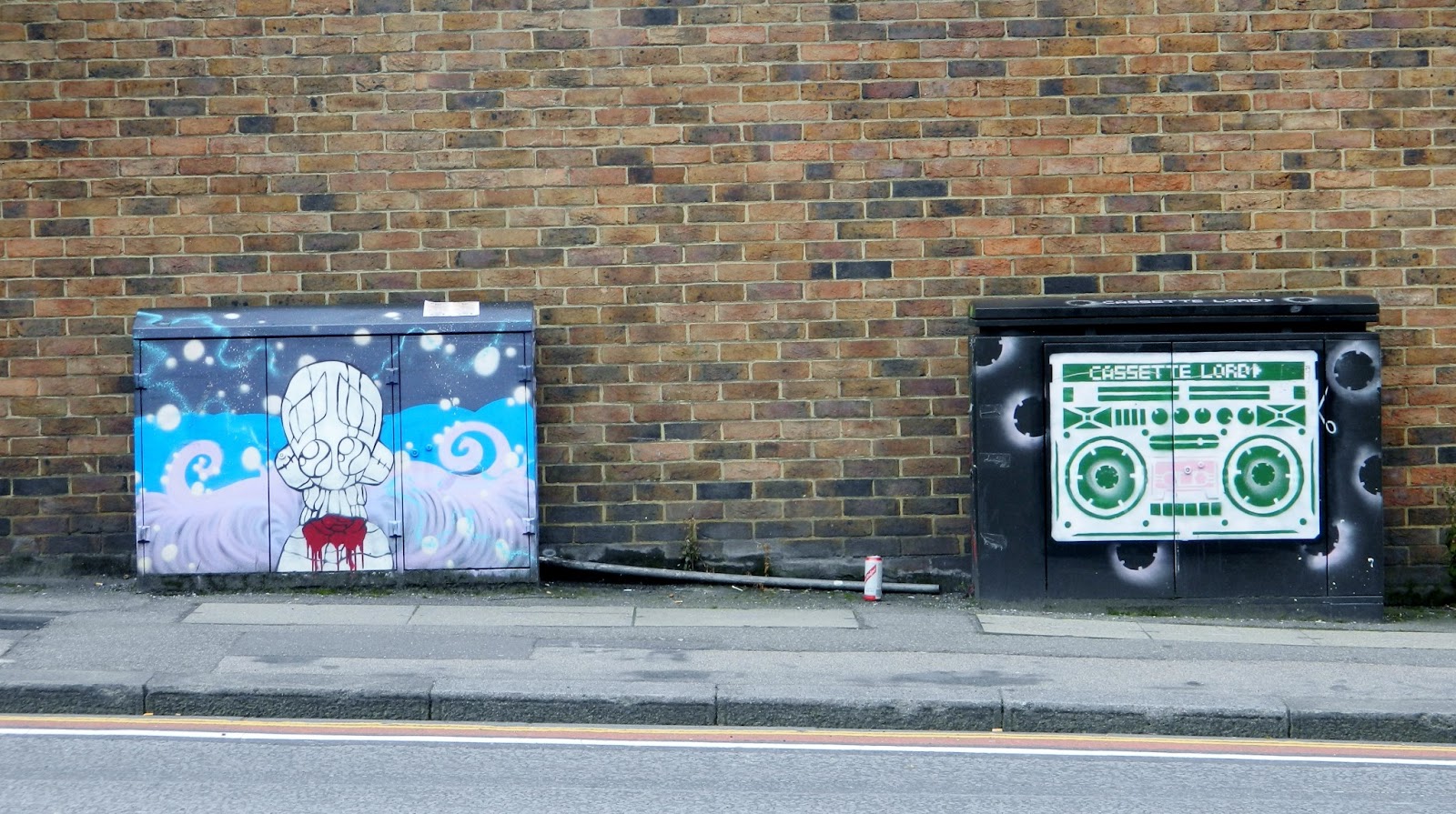
Junction box street art by Cassette Lord, Brighton - Photo by Billy Haworth
One of my favourite places to visit for a day trip out of London is Brighton. Brighton is a small city by the seaside in the south of England with an 'alternative' reputation. One of the reasons I like it so much is the fantastic display of graffiti and street art on offer. Brighton is a place that acknowledges the role street art plays in forming it's urban identity and, rather than removing all graffiti as 'vandalism', embraces this. On my last visit one of the first things I noticed as I left the train station was a painted traffic junction box. It wasn't just a group of tags like I may have come to expect around city railway lines, but a piece of artwork covering the entire box. Clearly this work was authorized, and as I ventured through the city during the day I saw more and more of these junction box artworks. I thought they were great, and had read about these types of council initiatives, but had never observed them all over an area like this before. Of course, I wanted to know more. I found out the signal boxes in Brighton began with local street artist, Cassette Lord. On his website Cassette Lord says the idea to stencil the junction boxes came about when a youth group finished a mural they noted the only part uncovered was the green junction box in front. 

"The boxes were mainly ignored and often a bit scruffy, we agreed this would be a great way to liven them up and give people something cool to look at and add to Brighton," (Cassette Lord).

Painted junction boxes, Brighton - Photos by Billy Haworth
The first time I came across the notion of painting traffic signal boxes was during the course of researching graffiti management strategies and patterns in Sydney, Australia. The example of painting traffic signal boxes came from Brisbane, QLD.  The initiative Artforce, established in 1999, aims to reduce the recurrent costs of graffiti removal by inviting local artists and residents to help decorate the boxes. A report by Catherine Ovenden (2007) evaluating the efforts of this strategy over a seven year period found that the reduction of graffiti on painted compared to unpainted boxes was consistent across Brisbane, with unpainted boxes accumulating graffiti three times faster than painted traffic signal boxes (Haworth et al., 2013). On the surface then it appears the introduction of Brisbane's "drive-through gallery" has had significant positive impacts. In terms of graffiti management, however, measures of success that focus only on reduction of graffiti have limitations, namely they fail to distinguish between different types of graffiti or to take account of the evolving dynamics of graffiti writing (See my recent paper: 'Spatio-temporal analysis of graffiti occurrence in an inner-city urban environment').


Other cities around the world too have adopted this initiative. Melbourne in Australia has followed in the footsteps of Brisbane's Artforce, introducing painted traffic signal boxes in a number in inner city suburbs in the hope that they will "reduce graffiti, provide opportunities for local artists and enhance local streets with new and vibrant art," (City of Yarra).  Tauranga City council in New Zealand claim "beautifully painted roadside artworks reduce the likelihood of them being tagged, while making a beautiful and intriguing creative feature in the urbanscape of the city," (Tauranga City).  The Painted Utility Box program in the city of Calgary, Canada, similarly aims to discourage graffiti vandalism by providing public space for original community art.  

These initiatives are centred on the same core goal: to reduce graffiti 'vandalism'.  And that is where my problem with this approach lies. When exactly is graffiti 'vandalism' and when is it 'art'? Who decides this? These initiatives are based on the assumption that all graffiti that might occur on these traffic signal boxes or elsewhere is 'vandalism' not worthy to remain on the traffic boxes, and the community pieces are 'beautiful' because they are 'art'.  The issue I have is that everyone has differing views on graffiti; what they like, what they don't like, what is appropriate, what is not, what is graffiti, what is art, and so on. These initiatives ignore that graffiti is a diverse subculture.  I fail to see how taking even more space away from someone wanting space to write will be an effective approach. Perhaps rather than creating spaces where people cannot write, authorities should focus more on providing spaces where they can write, thus discouraging writing in unwanted spaces. 

One comfort I take from the Brighton example is that at least the program was started by a street artist already writing on the streets aiming to add to the existing urban aesthetic, and not by a councillor in an office who is unlikely to have much experience of graffiti culture beyond the view of it as crime in their community. I don't mean to say community art projects are not welcome. Of course they are great for many different reasons, and many of the works I've seen on traffic boxes, particularly those by Cassette Lord, are really awesome! And I would certainly say that I prefer an approach to graffiti management that aims to exhibit local art as opposed to those many cities adopt that simply remove all graffiti as vandalism. I do question, however, the long-term success of a strategy to reduce graffiti that fails to understand the fundamentals of what graffiti culture is, and the diversity that comes with it. I suppose only time will tell.

Wednesday, 26 September 2012

Leake Street Graffiti Tunnel: Accepted and 'Cool'.


Hidden below the chaos of London's busy Waterloo Station lies a very different place where the interactions of the people in this bustling city are evident in a very different way. The Tunnel is an authorised graffiti area where writers can practice their craft without the fear of the societal consequences associated with writing in the majority of other places in the city. Works include anything from tags to more artistic forms of street art such as pieces or throw ups. I've even seen recently more elaborate forms of visual art and sculpture. Subject matters might be anything from identity or political messages to professions of love or contemporary culture. There is an image below of a great piece paying tribute to the late cultural icon, Amy Winehouse.

The thing that strikes me about this place is how 'cool' it appears. Speaking generally from the view of a society, why is graffiti and street art considered 'cool' when it's all together in one legal place, but not when it appears in its more organic and perhaps true form on our city's streets and walls? (Though, I know there are many people who would still consider this cool, and some even cooler simply for its illegal nature). Is it a bit 'not in my backyard', whereby people don't care what is going on as long as it isn't in their own space or interest? The 'broken windows' concept proposed by Wilson & Kelling in 1982 is also worth mentioning here. The concept states that a broken window left unrepaired gives a sense to the community that nobody cares, leading to more broken windows. Similarly, leaving graffiti unchecked can lead to an increase in graffiti in the area, thus adding to a feeling of disorder and disrepair. Perhaps with graffiti contained in one place that is not somebody's personal space these fears are reduced. I admit, even I probably wouldn't appreciate someone defacing my home.

But I still think there is a place for graffiti in our cities, and the simple existence of a space like The Tunnel shows that some people at least acknowledge that. For me that is probably what I find 'coolest' about this place. This is especially cool when compared to other places that do not have such spaces, such as the City of Sydney LGA for example, which currently has no legal space for graffiti writing, and is so heavy-handed in its removal of graffiti that graffiti was defined on their website (2004) as "any inscription, word, figure or word design that is marked, etched, scratched, drawn, sprayed, painted, pasted, applied or otherwise affixed to or on any surface of any assets and includes any remnants of same such as adhesives, glues, tape, shadows or colour variations remaining after removal."

Everyone has differing views on graffiti and street art, and often in the end that doesn't really matter anyway. Policy makers and people with authority still make the decisions for its management, and graffiti will continue to occur anyway, whether authorised or not. In my opinion, though, I think this place is rad. I love the art, I love the juxtaposition of paint and colour with the otherwise empty, utility feel of the unused tunnel. I love the interactions you witness between people; I love watching artists paint. I love the vibe, and I love the exposure. It's definitely one of my favourite places in London.


Photos by Billy Haworth